Published Monday, January 5, 2026
By Natalie Tucker
Why Color Choice Matters for Small Brands
When you’re building your brand, color is everything. It’s the first thing customers notice on your packaging and
the easiest way to make your products feel professional, consistent, and memorable.
But when it comes to printing your packaging, not all color systems work the same. You might’ve heard terms like
“spot colors” and “CMYK,” especially if you’ve ever uploaded artwork for print. Understanding the difference —
especially in a digital printing workflow — helps you create packaging that looks the way you imagine, without
overspending or delaying production.
What are Spot Colors?
Spot colors are specialized ink colors utilized in flexographic or lithographic printing, frequently specified
through the Pantone Matching System
(PMS) to ensure brand consistency. For instance, Coca-Cola red is a distinct hue
specifically developed for that brand.
Spot Colors in Digital Printing
Digital printing doesn’t use physical ink mixing in the same way flexo or offset printing do. Our single-pass
digital
printers contain millions of nozzles which spray ink onto corrugate. With digital printing, spot colors are
simulated
using CMYK values that get as close as possible to the intended tone. That means even if your artwork uses a Pantone
color, it’s converted to CMYK for digital output — and may look slightly different depending on your monitor and
substrate.
This is why it is important to order a Sample Box so you can see how the colors are printing digitally on the
material you have chosen. From there, you can adjust your artwork to get your color as close as possible to the
intended look and feel.
Advantages of Spot Colors
- Precise color match across print runs and substrates
- Ideal for metallics, fluorescents or custom pigments outside the typical CMYK gamut
- Consistent brand identity - your logo and brand colors stay true
Trade-Offs of Spot Colors
- Each spot color adds cost → more plates, more ink, more setup
- Less efficient for full-color photographs or designs with many hues
- Longer lead time for tooling/setup compared to purely digital or CMYK runs
- More expensive due to the higher level of production
What Is CMYK in Digital Printing?
CMYK stands for Cyan, Magenta, Yellow, and Key (Black) — the four base inks used in most digital printers. These
inks
combine in varying amounts to produce a wide range of colors.
For digital printing, CMYK is the standard and most efficient process. It’s what allows DIYPack to deliver
photo-quality, full-color packaging without plates, setup fees, or minimum orders.
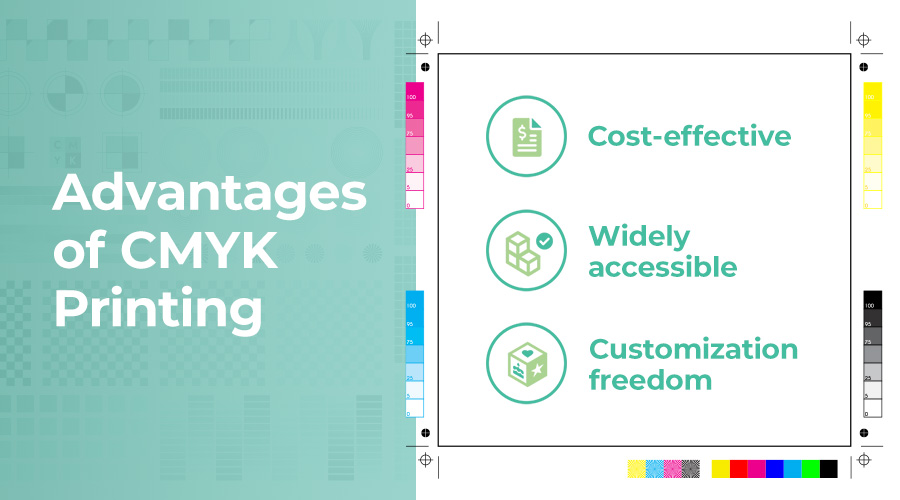
Advantages of CMYK digital printing:
- Full-color flexibility: Perfect for packaging that includes photos, or illustrations.
- Fast turnaround: No setup plates or ink mixing which is ideal for small runs or test batches.
- No minimums: Pay only for what you want to print.
- Sustainable: Digital printing reduces ink waste and setup materials.
Trade-Offs of CMYK
- Color match may not be as exact - brand colors can shift. Contact Us if you have more questions on how your
colors are going to look.
-
Digital print produces vibrant, high-quality color but does not replicate metallic, neon, or reflective finishes.
Gold, silver, and other specialty tones will print as flat colors. For the best results, we recommend ordering a
Sample Pack to see real printed colors before placing your full order.
Spot vs CMYK: A Digital Printing Comparison
| Feature |
Spot Colors (Traditional) |
CMYK (Digital) |
| Color Accuracy |
Excellent |
Very good for full-color designs; variations possible |
| Best For |
Brand colors, special inks |
Full-color artwork, photographs, many hues |
| Cost Implication |
Higher setup if many spot colors |
More efficient for many-color jobs |
| Turnaround Time |
Can be longer due to tooling & plates |
Faster, 5-7 day production time |
| Design Flexibility |
Less ideal for photo realism |
Excellent for realistic images & gradients |
| Sustainability / Waste |
Produces more waste than digital printing |
Highly efficient – minimal waste |
Choosing What’s Right for Your Packaging
If your packaging design is bold, colorful, or image-heavy — CMYK digital printing is your best friend. It gives you
flexibility with fast, sustainable, and affordable results.
If you’re aiming for absolute brand color precision (like a trademarked red or metallic accent), you can convert
your spot color to the closest CMYK equivalent values and purchase a sample. Just keep in mind that true Pantone
spot inks are typically used only in offset printing — not digital.
The good news? With DIYPack’s digital CMYK technology, you can test your packaging colors easily. Order a single
box,
review your print in person, and tweak your color choices before committing to a full run.
How DIYPack Makes Color Easy
- Digital CMYK Printing: High-quality, full-color output with quick turnaround.
- Flexible Quantities: Order one box or hundreds — no minimums required.
- Sustainable Materials: Printed on recyclable corrugate with water-based inks. Learn more about our sustainability approach.
- Try Before You Buy: Use our sample program to test your color
accuracy and get credit toward your first order.
Whether you’re designing for a launch, a subscription box, or a seasonal drop, DIYPack helps you bring your brand
colors to life — beautifully and sustainably.
Start designing your custom packaging today

About the Author